Engineer's Guide to Glass- vs. Carbon-Filled Polyamides
The Engineer's Guide
to Glass-filled vs. Carbon-filled Polyamides in SLS
Choosing the right material for high-stakes 3D printing shouldn't feel like playing roulette with your engineering budget. When standard nylons lack the grit for your most demanding applications, filled polyamides step up to do the heavy lifting. In the world of Selective Laser Sintering (SLS), two heavyweights dominate the arena: carbon fiber-filled PA 603-CF and glass-bead-filled PA 615-GS. While both offer a massive step up from standard plastics, they behave like entirely different beasts under stress, heat, and weight constraints. Let's break down the mechanics so you can stop guessing and start building with absolute confidence.
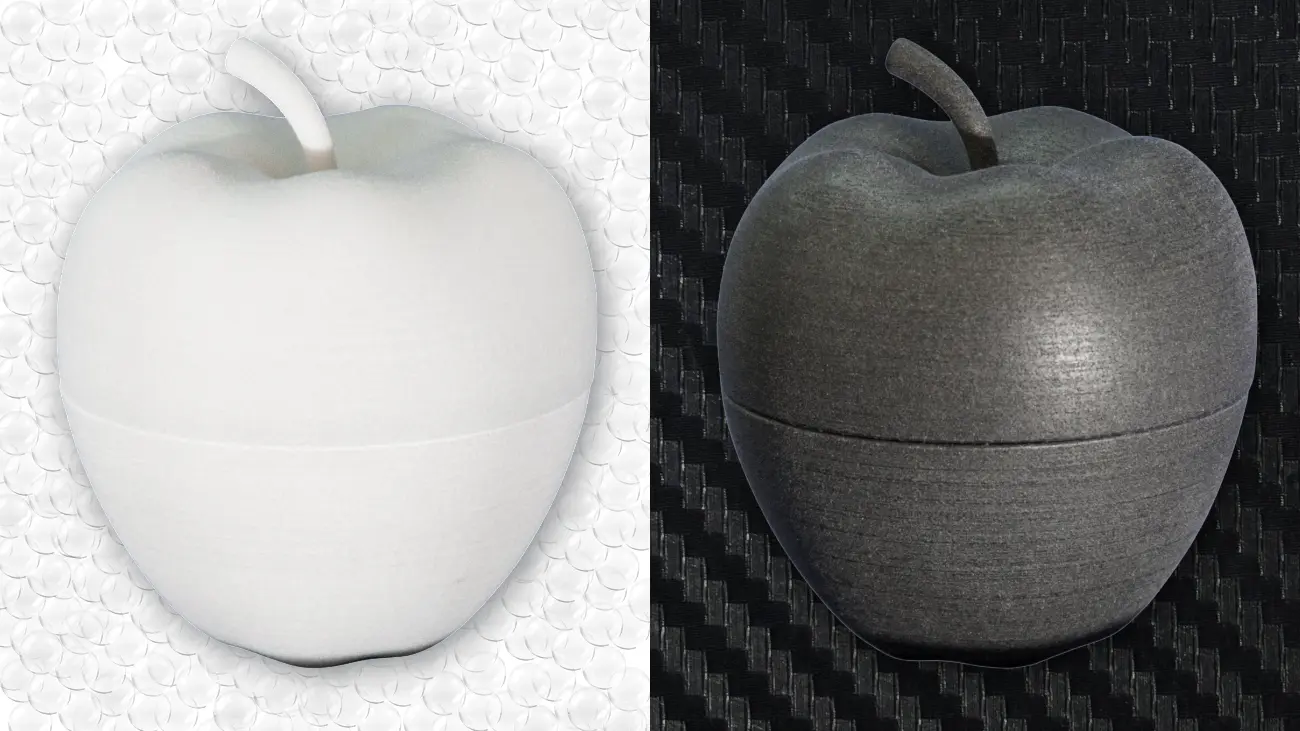
Finding the right material for demanding tooling applications shouldn't be a guessing game. When your project demands a material that won't back down under pressure, this dark gray PA 603-CF Carbon Fiber-filled nylon workhorse steps up. It is specifically engineered for environments where high heat tolerance, raw strength, and relentless wear resistance are absolutely critical. If your components need to survive harsh, punishing conditions, you can rely on this material to stand its ground.
Performance-wise, it delivers a massive leap in rigidity, offering a superior stiffness factor that easily outperforms standard High-Performance Nylon 12. But strength doesn't have to mean rough around the edges. When paired with our secondary finishing operations, the final result is an incredibly sleek, ultra-smooth part that looks as premium as it performs.
When you need parts that withstand heavy impacts and maintain their exact shape without warping, PA 615-GS Glass-filled nylon is your solution. It delivers exceptional durability and rock-solid stability, serving as a reliable workhorse for your production line.
Out of the machine, the material features a clean, slightly creamy eggshell finish that looks professional. It produces a heavier part than other options, so expect some substantial heft. When your project demands uncompromising strength, this material delivers exactly what you need to get the job done right. Because it performs reliably under pressure, we keep PA 615-GS fully stocked for quick turnaround times.
| Selection Criteria | Prefer PA 603-CF (Carbon Fiber) | Prefer PA 615-GS (Glass Bead) |
|---|---|---|
| Material Base | PA 2200 Nylon 12 + ~30-33% Carbon Fiber | PA 2201 Nylon 12 filled with glass beads (~ 40-50 wt%) |
| Material Color | Dark Gray | Eggshell / Creamy White |
| Appearance | Dark charcoal/black | Off-white/egg-shell |
| Surface Finish | Matte, somewhat rougher due to fibers | Smooth, uniform matte finish with excellent cosmetic appearance |
| Sintered Density | 1.10 g/cm³ (Lightweight) | 1.49 g/cm³ (Heavier) |
| Tensile Strength | 85 MPa (High load bearing) | 38 MPa (Moderate load) -- check on this |
| Tensile Modulus | 7,900 MPa | 5,900 MPa |
| Flexural Modulus | 9,170 MPa | 3,300 MPa |
| Elongation at Break | 4% | 2% |
| HDT @ 1.82 MPa |
173°C | 134°C |
| HDT @ 0.45 MPa |
179°C | 179°C |
| Mechanical Strength | Extremely high tensile and flexural strength | Good stiffness with lower tensile and impact strength than PA603-CF |
| Dimensional Stability | Very good | Excellent |
| Electrical Properties | Electrostatic Dissipative (ESD-safe, surface resistivity approximately 10³–10⁶ Ω/sq depending on print orientation and processing) | Standard insulating/non-conductive |
| Primary Goal | High strength-to-weight, absolute rigidity | Dimensional stability, isotropic accuracy |
| Primary Advantage | Exceptional rigidity, low weight, and ESD properties | Superior surface finish, low warpage, and fine feature detail |
| Ideal Use Cases | Jigs, fixtures, UAV parts, lightweight structural elements, and ESD-sensitive enclosures | Housings, snap-fit components, tooling, and dimensionally critical precision components. Chemical resistance: Alkalines, hydrocarbons, fuels, solvents |
-
Structural Mechanics & Rigidity
When you need a part that absolutely refuses to bend, snap, or compromise, carbon fiber is your go-to. PA 603-CF packs a serious punch with a tensile strength of 85 MPa and a massive tensile modulus of 7,900 MPa. In plain English, it is incredibly stiff, remarkably strong, and lightweight enough to keep your project from feeling like a brick. It is the heavyweight champion of structural rigidity, without the actual weight.
On the flip side, glass-filled nylon plays a slightly different game. PA 615-GS swaps out those aggressive fibers for tiny glass beads, giving you a material that excels at holding its shape under heavy, crushing pressure. While it trades away some pulling strength—clocking in around 38 MPa—and handles high impacts with a bit less flexibility, it remains an absolute rock under compression. Think of it as the stable, unyielding anchor for components that need to stay exactly where you put them.
-
Weight & Density
When it comes to keeping things lightweight, carbon fiber takes the crown without breaking a sweat. PA 603-CF is highly optimized for lean, structural designs, clocking in with a sintered density of just 1.10 g/cm3. It gives you all the muscle you need without forcing your project to drag around extra baggage.
Glass-filled PA 615-GS nylon, however, brings some serious heft to the scale. That 50% glass fill packs on the mass, bumping the density up to 1.49 g/cm3. If you are balancing a razor-thin weight budget—especially in aerospace or uncrewed systems—that extra bulk is a massive penalty. Choose wisely, because every gram counts when you are trying to get off the ground.
-
Thermal Performance
When things start heating up, both materials hold their ground remarkably well, but they handle the pressure a bit differently. If your components are going to be living in a high-stress, high-heat kitchen, carbon fiber is your master chef. PA 603-CF shrugged off distortion up to 179°C even under heavy loads. It refuses to warp or lose its shape when temperatures spike, making it the ultimate choice for withstanding brutal thermal environments without flinching.
Glass-filled nylon takes a slightly different approach to the heat. PA 615-GS keeps your parts incredibly stable during everyday temperature swings, but it will start to bow a bit sooner under a combined assault of heavy weight and high heat, softening at 134°C under full load. However, if you give it a little breathing room by reducing mechanical stress, its tolerance jumps to a comfortable 179°C. It is highly reliable for keeping dimensions precise, but don't ask it to carry the weight of the world when the thermostat peaks.
-
Dimensional Stability vs. Isotropy
When it comes to keeping your parts perfectly true, shape matters more than you think. PA 615-GS relies on tiny glass beads instead of jagged fibers. Because a ball looks the same from every single angle, this material shrinks uniformly in every direction during printing. It eliminates the internal tug-of-war that causes warping. If you are building complex, flat, or tightly toleranced enclosures that absolutely must remain dead flat, this is your secret weapon.
Carbon fiber, on the other hand, requires a bit more finesse. PA 603-CF uses chopped fibers, which act like tiny logs in a river—they tend to line up in certain directions as the printer spreads the powder and fires the laser. This directional bias means the part can shrink differently along its length than its width. It is nothing an expert build layout can't handle, but it does mean you have to plan your part orientation carefully to keep those directional stresses from twisting your design.
-
Application Environment (ESD & Wear)
When you are housing sensitive electronics, managing electricity is half the battle. PA 603-CF offers built-in Electrostatic Discharge protection, courtesy of its carbon fiber network. It safely channels static away from your delicate components, acting like a bodyguard for your circuitry. PA 615-GS, on the other hand, takes the opposite approach. It is entirely non-conductive, serving as an excellent electrical insulator for projects that need to keep currents locked down and completely isolated.
However, if your design involves moving parts that constantly rub together, you need to watch out for friction. The tiny glass beads packed into PA 615-GS can turn the material into a sheet of sandpaper over time, grinding down any mating surfaces it touches. PA 603-CF handles these sliding interactions much more gracefully. If your project involves a lot of friction and moving components, sticking with carbon fiber will save you from premature wear and tear.
In the showdown between carbon and glass, the right choice ultimately depends on your project's primary enemy. If you are fighting a strict weight budget or battling intense heat and pulling forces—especially in weight-sensitive fields like aerospace or uncrewed systems—carbon-filled PA 603-CF is your undisputed champion. However, if your target is a rock-solid, warp-free enclosure that must withstand crushing compressive loads and maintain flawless dimensions, the isotropic glass beads in PA 615-GS have your back. Match the material to the mission, and you'll end up with parts that don't just survive but conquer.
For more information on these materials or to see what else we offer, check out our SLS materials page. Every project is unique, which is why you need to be selective with your materials. If you’re unsure which material is best for your product, we’ll help you determine the right choice. contact our team to witness firsthand how we can bring your imagination to life! Request an SLS 3D printing quote and upload your CAD files today!